Grill Bill
Direct and indirect cooking on the kamado

Direct and indirect cooking on the kamado

Bobby

When do you cook directly and when indirectly on the kamado?

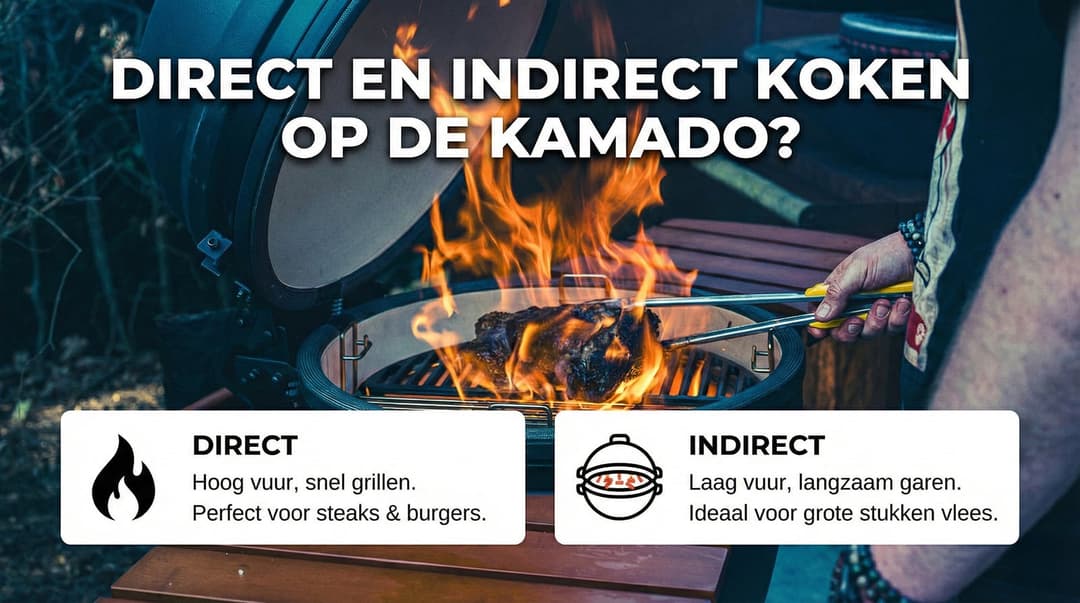
With direct cooking your food sits above the coals without a heat deflector: fast, hot and with a crisp crust, for steaks, burgers, fish and vegetables. With indirect cooking a heat deflector sits between the coals and the grate and the kamado works as an oven, usually between 110 and 180 °C, for whole chicken, ribs, pulled pork, bread and pizza. Rule of thumb: if it needs to cook for more than half an hour, go indirect.
  • Direct: no deflector, heat from below, searing and crust
  • Indirect: deflector in between, convection heat, oven effect at 110 to 180 °C
  • Cooking for more than 30 minutes? Indirect
  • You can combine them: cook indirectly first, then sear directly
  • For both: lid closed and small steps on the vents

Direct or indirect is the first choice you make when you light the kamado, even before you think about temperature. The difference comes down to one part: the heat deflector. Without it, you grill above the coals. With it, you bake and roast like in an oven.

Below you read what both techniques are, why they work differently on a kamado than on an open barbecue and when to choose which. Want to know first how ceramic holds heat? Then read What makes ceramic cooking different?.

What is direct cooking?

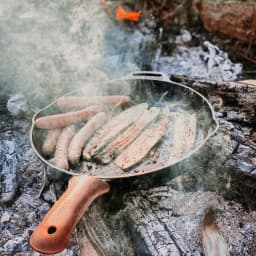
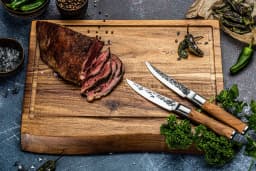
With direct cooking your food sits right above the fire, without a heat deflector between the coals and the grate. The heat comes mainly from below. This is ideal for quick dishes such as steaks, burgers, fish and vegetables.
Still, direct cooking on a kamado is different from an open grill. Thanks to the ceramic and the closed bowl, heat does not just stay under the grate but circulates through the whole kamado. So on top of direct heat you also get convection heat.

Want to understand how that circulation works first? Read What is convection heat in a kamado?

Why direct cooking on a kamado is less aggressive

On an open barbecue direct heat is often fierce and restless. Flames shoot up and the temperature swings a lot. A kamado dampens this. The ceramic absorbs heat and radiates it back evenly, which makes the heat calmer and easier to control.

That means you burn food less quickly, have more control over colour and crust and can work above direct heat for longer without stress.

When do you choose direct cooking?

You use direct cooking when you want speed and high heat. Think of:

  • Steaks and burgers
  • Fish fillets and shellfish
  • Vegetables with a short cooking time
  • Quick snacks or side dishes

For larger or thicker cuts of meat, direct cooking is often only part of the process, for example in combination with indirect cooking.

What is indirect cooking?

With indirect cooking your food does not sit directly above the fire. You place a heat deflector between the coals and the grate. This blocks the direct radiant heat and your food cooks on circulating convection heat.

The heat moves through the whole kamado and surrounds the food from all sides. That gives even cooking without burning. This way of working is closely linked to convection heat, more on that in What is convection heat in a kamado.

The heat deflector is essential here. This ceramic or stone plate blocks the direct heat and forces the warmth to circulate along the sides and upwards. That turns your grill into an oven.

Why indirect cooking works so well in a kamado

The ceramic of a kamado stores heat and releases it slowly. Together with a stable airflow this creates a calm and predictable heat source. That makes indirect cooking particularly suited to larger or thicker products.

Unlike an oven, a kamado still works with charcoal, which adds extra flavour without smoke taking over. Because of the closed design more moisture is retained, so meat stays juicier.

When do you choose indirect cooking?

You use indirect cooking for anything that needs time to cook evenly without burning. For example:

  • Whole chicken or large poultry
  • Ribs and pulled pork
  • Braising and baking
  • Pizza and bread
  • Low & slow cooks

For quick products direct cooking is better. In practice you often combine the two, as you will read next.

Combining direct and indirect

Many dishes get the best of both. With a reverse sear you first cook a thick steak indirectly to just below the target core temperature and then sear it briefly over direct heat for colour and crust. How that works exactly is explained in Reverse sear on a kamado.

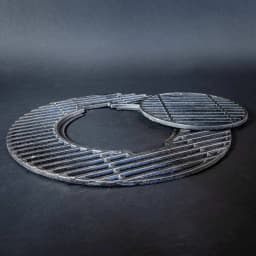
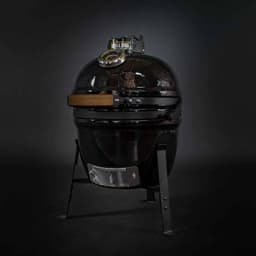
You can also cook directly and indirectly at the same time. All Pro kamados have the Smart Qooking System, a multilevel system that lets you work at different heights: one dish close to the coals, the other higher up and shielded. That way you set up temperature zones in a single kamado.

Airflow: decisive for both

Whether you cook directly or indirectly, airflow determines the temperature. The bottom vent controls how much oxygen the fire gets, the top vent stabilises the exhaust of warm air. More oxygen gives a more active, hotter fire, less oxygen makes it calmer.

With indirect cooking you want calm, stable combustion. With direct cooking the fire may be more active, but even then maximum heat is rarely needed. A kamado reacts slowly, so think ahead instead of correcting afterwards: small adjustments and some patience work better than big corrections. More on this in Airflow in a kamado explained.

Common mistakes

  • Direct: thinking it always has to be as hot as possible
  • Direct: turning or moving the food too often
  • Indirect: expecting it to go fast, and too little patience while the temperature settles
  • Both: opening the lid all the time
  • Both: adjusting the vents too often and too much

These mistakes lead to burning, drying out or a restless fire. In common kamado mistakes you read why that happens.

FAQ

How do you know whether to cook directly or indirectly?
Want to sear? Direct. Want to cook slowly? Indirect. A simple rule: if it takes longer than 30 minutes, cook indirectly. Baking pizza? Indirect too!
What is direct cooking on a kamado?
Direct cooking means cooking over an open fire without a heat deflector, with the heat coming straight from the coals and topped up by convection heat.
What is indirect cooking on a kamado?
Indirect cooking means cooking without direct heat from the coals, with a heat deflector providing even convection heat.
Which temperature do you use for indirect cooking?
Usually between 110 and 180 degrees, depending on the dish and the doneness you want.
Does direct cooking always have to be at a high temperature?
No, control matters more than maximum heat. Cooking too hot only increases the risk of burning.
Why should the lid stay closed during indirect cooking?
Because opening it disrupts the convection flow and lets heat escape, which affects the result.
Can I combine direct and indirect cooking?
Yes, this often happens with techniques like reverse sear, where you cook indirectly first and then sear directly.
Does indirect cooking work better on ceramic?
Yes. The ceramic stores heat and releases it evenly, so your food cooks evenly and stays juicy. A chicken still gets crispy skin.
Why does my food keep burning when cooking directly?
Usually because of too much airflow, opening the lid too often or a lack of control over the fire.

More from the techniques

This article is part of kamado techniques, chapter 4 of the kamado BBQ guide: direct and indirect, low and slow, smoking and baking.

Written by
Bobby

Bobby

Bobby founded Grill Bill and has been cooking on ceramic kamados for years. His background is in tech, design and marketing, and it shows on the site you are reading right now: he designed and built grillbill.eu himself, on his own platform Neuramerce, from the recipes and the dealer finder to the checkout. Here he writes about low and slow, smoking, grilling and baking on the kamado, drawing on the thousands of customers he helped get going with their first Grill Bill.

Fire up

Once a month,
a real letter.

Recipes, drops and long essays about smoke. No noise, never resold.

In this category
20% bundle discount

On accessories you order together with your kamado.

View the Pro III
In this category
Kamado arayes with guacamole

View recipe
Made withNeuramerce